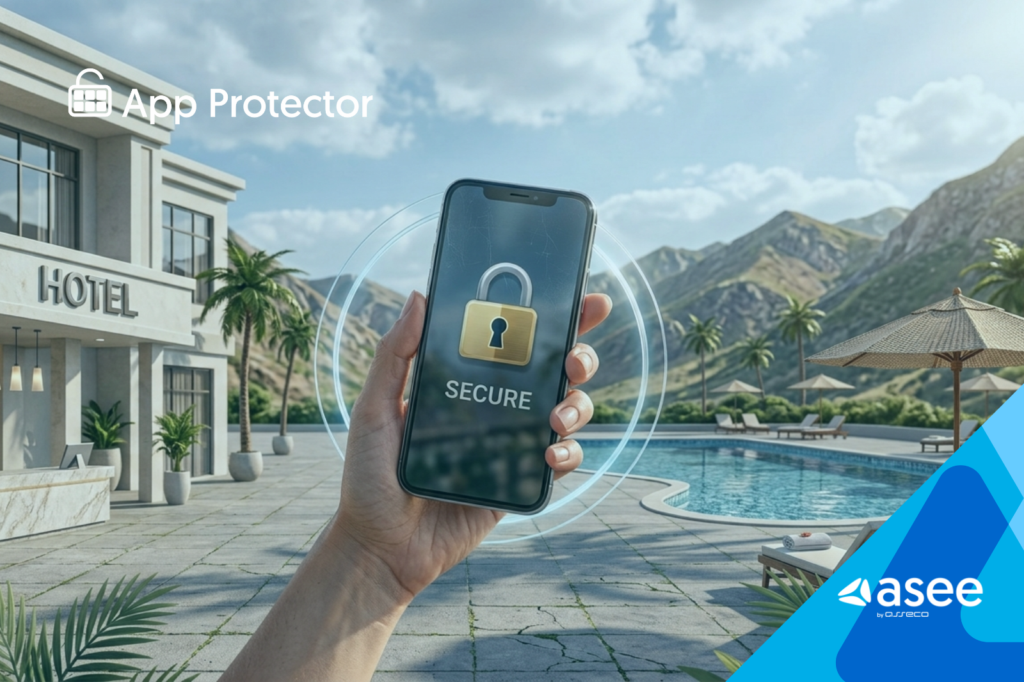
Why Mobile Apps Are Now Key for Hospitality Businesses — and Why Security Can't Wait
The hospitality industry has spent the last decade digitalising the guest experience. Check in from your phone. Unlock your room with an app. Earn and redeem loyalty points without ever speaking to a human. Order room service, book a spa treatment, request a late checkout, all from a single, elegant mobile interface.
Today, mobile apps for hospitality are the primary touchpoint between hotels and their guests — and they carry more sensitive data than ever before.
It's a remarkable shift. And it has quietly created one of the most underprotected attack surfaces in enterprise technology.
Here's the uncomfortable truth: while hotel chains have invested heavily in making their mobile apps seamless, very few have invested proportionally in making them secure. The app that holds a guest's passport details, payment credentials, loyalty currency, and physical access to their room is often protected by little more than the assumption that no one is looking closely enough to break it.
That assumption is wrong. And it's becoming more wrong every year.
The Mobile App Is Now the Hotel
Why are mobile apps key for hospitality businesses? Because they've replaced every traditional guest touchpoint — check-in, concierge, room keys, loyalty programmes, and payments — all within a single hotel mobile app.
Ten years ago, a hotel's digital footprint was relatively contained: a booking website, a property management system, a payment terminal. The attack surface was wide enough, but at least it was understood.
Today, the mobile app has swallowed almost every guest touchpoint. It is the check-in desk, the concierge, the room key, the loyalty wallet, and the payment processor. All in one binary, running on a device the hotel does not own or control.
That matters enormously from a security perspective. When you distribute a mobile app, you are handing attackers a copy of your software to examine at their leisure. On a rooted Android device or a jailbroken iPhone, a determined attacker can decompile your app, trace its authentication logic, intercept its API calls, and map every pathway to your backend systems. And your security team has no idea it's happening.
This is not theoretical. Security researchers have already demonstrated it. At Black Hat, researchers show how a hotel mobile key system could be defeated through wireless sniffing and replay attacks. The result? Handing an attacker physical access to guest rooms. Separate research demonstrates that hotel loyalty apps can be reverse engineered to expose backend authentication flows, allowing reservation data for any guest to be retrieved by manipulating a single parameter in an API request.
These aren't sophisticated nation-state attacks. They're the kind of work a motivated attacker with freely available tools can accomplish over a weekend.
What Attackers Are Actually After
Before dismissing this as a niche concern, consider what a compromised hotel mobile app actually yields.
Loyalty points represent real monetary value. Millions of unredeemed currency sitting in program databases, transferable, spendable, and highly liquid on underground markets. Account takeover via a poorly protected mobile app is one of the most efficient paths to that value.
Payment credentials and personal data (names, addresses, passport numbers, travel itineraries) are also valuable targets. The more a hotel app centralises guest data for the sake of personalisation, the richer the payload becomes for anyone who can extract it.
And then there is physical access. As mobile room keys become standard across major chains, the app is no longer just a digital interface. It is a physical security control. The implications of a tampered or cloned key app extend well beyond data loss.
The Three Gaps Most Hotel Apps Leave Open
In our work with organisations undergoing mobile security assessments, we see the same structural weaknesses appearing repeatedly in hospitality apps. They are not exotic vulnerabilities. They are gaps that exist because mobile app security does not hold the same rigour as network or infrastructure security.
The first gap is the unprotected runtime. Most hotel apps have no meaningful defence against being run in a compromised environment. On a rooted or jailbroken device, an attacker can hook into the app's runtime, intercept decrypted data, bypass authentication checks, and manipulate business logic in real time. Without runtime protection, the app behaves identically whether it's running in the hands of a legitimate guest or on an attacker's analysis workstation. That's an extraordinary level of trust to place in an uncontrolled environment.
The second gap is readable code. The average hotel app ships with source code that, once decompiled, is largely legible to anyone with basic reverse engineering skills. API endpoints, authentication logic, encryption keys, backend URLs. An attacker can extract and use it to craft attacks against the server infrastructure. Code obfuscation is not a silver bullet, but it transforms this from a weekend project into a months-long undertaking that most attackers will abandon. Raising the cost of an attack is, itself, a meaningful security control.
The third gap is the absence of integrity verification. Repackaging and redistribution of hotel apps on third party app stores is fairly common. A fake version of a major hotel chain's app, visually identical to the original, but instrumented to harvest credentials, is a trivially executable phishing attack. Without integrity checks within the app itself, neither the hotel nor the guest has any assurance that the software running on the device is the original software. Our Mobile App Integrity Check closes this gap by verifying at runtime that there is no tampering, modifying, or repackaging the app.
The Regulatory Pressure Is Coming
There is a further dimension that hospitality technology leaders should be paying attention to: regulatory exposure.
GDPR has already cost Marriott over €18 million in fines following its breach. Enforcement of mobile-specific security obligations is tightening globally. The EU's Digital Operational Resilience Act (DORA) and the broader movement toward mandatory security-by-design standards mean that "we didn't know the app was vulnerable" will increasingly fail as a defence with regulators.
Mobile app security is moving from a technical nice-to-have to a compliance requirement. The organisations that get ahead of this now will be in a far better position than those who wait for an incident to force the conversation.
Security That Doesn't Compromise the Experience
One objection we hear consistently from hospitality technology teams is performance. A hotel app that introduces friction, slow load times, false-positive lockouts, intrusive security prompts, undermines the seamless guest experience the app was built to deliver.
It's a legitimate concern, and it's one we've designed around. Runtime protection, obfuscation, and integrity checks, implemented well, are invisible to the legitimate user. The guest who checks in smoothly, unlocks their room, and earns their loyalty points notices nothing. The attacker who attempts to decompile the app, run it on a rooted device, or distribute a repackaged clone hits a wall.
That is exactly how security should work.
The Window Is Open. The Question Is Whether You Close It First.
The hospitality industry's mobile moment is not coming, it has arrived. Guests expect mobile-first experiences, and the chains that deliver them are winning loyalty. But every hotel app that ships without runtime protection, readable code, and no integrity verification is an open invitation.
The breaches that defined the last decade in hospitality (Marriott, MGM, Caesars) largely originated in network and infrastructure layers. The next wave will be different. Attackers follow value and opportunity, and both are increasingly concentrated in the mobile app layer.
The question isn't whether hotel apps will be targeted more aggressively. They already are. The question is whether your app will be the one that stops an attacker, or the one that ends up in a breach disclosure.
Frequently Asked Questions
Apply for Your Free 30-Day App Protector Trial
Get full access to advanced mobile security for 30 days, featuring both App Hardening to make your app tamper-proof and App Shielding to actively detect and block attacks in real time. Explore a user-friendly portal and see how your app stays protected at every stage. No upfront payment needed.