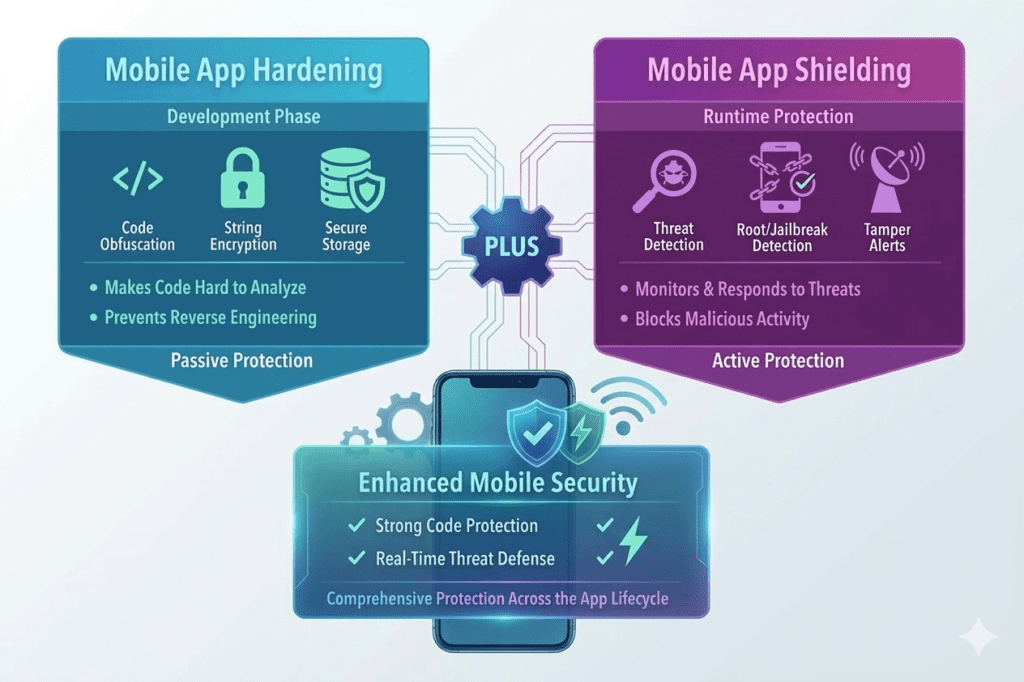
Mobile app hardening and mobile app shielding are both security mechanisms. While mobile app hardening protects code before deployment, mobile app shielding protects the app during runtime. Both are required because they address different stages of the attack lifecycle and create layered mobile security.
Mobile applications have become the primary interface between businesses and users. Banking, healthcare, e-commerce, and enterprise productivity rely on mobile apps to deliver critical services and handle sensitive data. But this convenience also makes mobile apps a high-value target for attackers.
The scale of the threat is significant. Cybersecurity reports show that more than 33 million mobile attacks were blocked in 2024 alone, averaging about 2.8 million attacks per month targeting smartphones.
Mobile malware and unwanted applications are also rising rapidly, with over 12 million attacks recorded in just the first quarter of 2025 on Android devices.
At the same time, application-level threats are increasing. In one industry report, the likelihood of attacks targeting Android apps rose from 34% in 2023 to 84% in 2024, showing how aggressively attackers are targeting mobile software itself.
Given this landscape, protecting the mobile application itself, not just backend systems, has become a core component of modern security strategies.
Two key techniques used to protect mobile apps are mobile application hardening and mobile application shielding. Although these terms are often used interchangeably, they address different stages of the attack lifecycle and serve different security purposes. Mobile app hardening and mobile app shielding are complementary protection approaches: hardening strengthens an app during development to remove weaknesses, while shielding adds runtime protection to defend the compiled app against active attacks.
Understanding the difference and how they work together is essential for building secure mobile applications.
What Is Mobile App Hardening?
Mobile app hardening is the process of improving an application’s security posture during development and refers to techniques that strengthen an application’s code and binary to make it more resistant to analysis, reverse engineering, and exploitation.
Unlike runtime defenses, hardening typically occurs during the development and build phase. The goal is to reduce the attack surface and make it significantly harder for attackers to understand how the application works.
This is particularly important because mobile apps run on untrusted devices. Attackers can download the application, decompile it, analyze the code, and attempt to manipulate its logic.
Hardening techniques help slow attackers down and protect sensitive application logic, intellectual property, and security mechanisms.
How Mobile App Hardening Works and What Are The Key Techniques
Code Obfuscation
One of the most widely used hardening techniques is code obfuscation, which transforms application code into a form that is difficult for humans to understand.
Common obfuscation methods include:
Renaming classes and functions
Control flow obfuscation
String encryption
Removing debugging information
Even though an attacker may still be able to decompile an app, obfuscation ensures the resulting code is difficult to interpret or manipulate.
For example, a mobile banking application may obfuscate its transaction validation logic to prevent attackers from identifying how transfers are verified.
Secure Secret Management
Hardcoded secrets, such as API keys or encryption keys, are a common weakness in mobile apps.
Attackers who reverse engineer an application often search for exposed credentials inside the binary. Secure secret management reduces this risk by using secure storage mechanisms.
Best practices include:
Using platform security features such as Android Keystore or iOS Keychain
Avoiding hardcoded credentials
Generating keys dynamically when possible
These measures prevent sensitive secrets from being easily extracted from the application.
Secure Networking and Certificate Pinning
Mobile apps frequently communicate with backend APIs, making network security critical.
Without proper protections, attackers can intercept traffic through man-in-the-middle (MITM) attacks.
Hardening techniques in this area include:
Enforcing HTTPS and strong TLS configurations
Implementing certificate pinning
Preventing connections to untrusted certificates
Certificate pinning ensures the mobile app only communicates with trusted backend servers, even if an attacker attempts to intercept the connection.
Secure Storage
Mobile applications often store local data such as authentication tokens, session information, or cached user data.
Hardening practices aim to prevent attackers from extracting this information.
Typical approaches include:
Encrypting sensitive data at rest
Avoiding plaintext storage
Securing local databases
Using platform-provided secure storage APIs
Dependency and Build Security
Modern mobile apps rely heavily on third-party libraries and SDKs.
While these dependencies accelerate development, they can also introduce vulnerabilities.
Secure development teams reduce this risk by:
Regularly scanning dependencies for vulnerabilities
Removing unused libraries
Applying security checks within CI/CD pipelines
These practices help prevent attackers from exploiting weaknesses introduced through the software supply chain.
What Is Mobile App Shielding?
While hardening focuses on strengthening the application before it is released, mobile app shielding focuses on protecting the application while it is running on the device.
Mobile App Shielding introduces runtime defenses that detect and respond to attacks in real time.
These techniques are often associated with Runtime Application Self-Protection (RASP), where the application actively monitors its environment and behavior for suspicious activity.
Mobile App Shielding is particularly important because attackers often manipulate mobile apps during execution using debugging tools, emulators, or instrumentation frameworks.
Runtime protections help detect and block these activities.
How Mobile App Shielding Works and What Are Common Mobile App Shielding Techniques
Root and Jailbreak Detection
Rooted or jailbroken devices remove many of the operating system’s built-in security restrictions.
Attackers frequently use these devices to bypass application protections.
Root and jailbreak detection mechanisms allow the app to identify compromised devices and restrict functionality if necessary.
This is why many banking apps refuse to run on rooted/jailbroken devices.
Debugger Detection
Attackers often attach debuggers to applications to observe behavior and modify execution flow.
Debugger detection techniques attempt to identify when a debugger is attached and respond accordingly.
Typical responses may include:
terminating the application
disabling sensitive functionality
triggering additional security checks
Emulator Detection
Emulators are frequently used by attackers and researchers to analyze mobile applications.
Mobile App Shielding mechanisms can detect when the app is running in an emulator environment instead of a physical device.
If an emulator is detected, the application may limit functionality or shut down entirely.
Hooking Detection
Attackers commonly use hooking and instrumentation frameworks such as Frida or Xposed to manipulate application behavior at runtime.
These tools allow attackers to:
bypass authentication checks
modify application logic
intercept sensitive data
Mobile App Shielding techniques attempt to detect these frameworks and prevent them from interacting with the application.
Tamper Detection and Anti-Repackaging
A common attack against mobile apps involves modifying the application binary and redistributing it.
Attackers may:
remove security controls
inject malware
modify payment logic
enable cheating in games
Tamper detection mechanisms check the integrity of the application during runtime.
If the binary has been altered or repackaged, the application can detect the change and prevent execution.
Mobile app Hardening vs. Mobile app Shielding: Key Differences in Mobile App Security
Feature
Mobile App Hardening
Mobile App Shielding
Protection Focus
Protects application code and binaries
Protects the application during runtime
Implementation Phase
Code obfuscation, string encryption, and secure storage practices
After installation, while the app is running on the user’s device
Goal
Make the app difficult to analyze, reverse engineer, or tamper with
Detect suspicious activity and attacks in real time
Techniques
Reduces the likelihood that attackers can understand or manipulate the app
Passive protection (increases effort required for attack)
Active protection (monitors and responds to attacks)
Primary Effect
Reduces likelihood that attackers can understand or manipulate the app
Detects and responds to malicious activity while the app runs
Role in Security Layer
Aims to slow down attackers
Aims to respond to attacks in real time
Complementarity
When combined with shielding, strengthens security across multiple attack stages
When combined with hardening, provides comprehensive protection throughout the app lifecycle
Why Combining Mobile App Shielding and Mobile App Hardening Works Best
Relying on a single layer of defense is rarely sufficient in mobile security.
Mobile app hardening alone may make an application difficult to analyze, but a determined attacker could still eventually reverse engineer it.
Mobile app Shielding alone may detect attacks, but if the application code is easily readable, attackers may quickly identify ways to bypass protections.
A blended approach combining both mobile app hardening and mobile app shielding significantly increases the effort required to compromise an application.
This layered model provides several advantages:
Mobile app Hardening slows reverse engineering efforts
Mobile app Shielding detects runtime manipulation
Integrity checks prevent repackaged applications
Runtime defenses respond to active attacks
Organizations in high-risk industries, such as banking, fintech, healthcare, and gaming, often implement both techniques as part of a defense-in-depth strategy. Without mobile app hardening, vulnerabilities may exist in production. Without mobile app shielding, protected code can still be analyzed and bypassed on compromised devices.
Mobile App Hardening vs. Mobile App Shielding FAQ
Mobile app hardening refers to techniques used to strengthen an application’s code and binary to make reverse engineering and exploitation more difficult. This typically includes code obfuscation, secure storage practices, and network security mechanisms.
Mobile app shielding focuses on protecting the app at runtime. It uses techniques such as root detection, debugger detection, and tamper detection to identify and respond to attacks while the application is running.
No. Mobile app Hardening protects the application code before deployment, while mobile app shielding protects the application during execution. They address different stages of the attack lifecycle.
The need depends on the risk profile of the application. Apps handling sensitive data, financial transactions, or intellectual property benefit most from these protections.
In some cases, determined attackers may eventually bypass protections. However, mobile app hardening and mobile app shielding significantly increase the time, expertise, and resources required to compromise an application.
Industries with high security requirements often rely on these techniques, including:
enterprise software
banking and fintech
healthcare
telecommunications
mobile gaming
Apply for Your Free 30-Day App Protector Trial
Get full access to advanced mobile security for 30 days, featuring both App Hardening to make your app tamper-proof and App Shielding to actively detect and block attacks in real time. Explore a user-friendly portal and see how your app stays protected at every stage. No upfront payment needed.